I improved my search experience by replacing Google Search with the paid search engine Kagi
Intro
In recent years, I’ve noticed a trend: the search experience has gotten worse. I can’t pinpoint the exact time when it happened, but it was somewhere around the start of the LLM hype cycle. It’s a very subjective feeling that it has become harder to find the information I’m looking for. Part of the reason is AI search suggestions in Google; another part is the amount of sponsored content in the results. It may also be that some high-quality websites lost the war of search engine optimization and are now hardly discoverable.
I tried to find an alternative to Google even before LLMs, including DuckDuckGo, Startpage, Brave Search, many others, and even Bing. I was motivated to switch each time, and it never worked out. Usually, I tried to find something, couldn’t do it using those search engines, then tried Google, and it worked for that case; as a result, I slowly transitioned back.
At one point, I discovered Perplexity and was fascinated by the search experience it provided. I started using it heavily, bought a subscription, and recommended it to everyone I know. After a short love cycle, I understood that I rarely need an AI to do the search. In most cases, I need to find something specific and precise. I don't need a “fast answer” but materials that I can process myself. Perplexity (and any AI search) does not work like that. It provides you with answers and narrows your view. It's good if you want to get an answer fast (even if not correct) or you don't have a certain question in mind, and you dump all related keywords into it and tell it to find something fitting to this criterion. But such cases do not happen that often to me. And it's not worth paying $20/m for it.
In addition, for me, it's more important to make a decision myself than to make the right decision. So each time I collect all necessary information and exercise my critical thinking:
- What place is best to stay in a new city?
- What are the visa requirements, and what unwritten rules are best to follow?
- What tools should I use for a new project?
- What book should I read next?
Even if my decision was wrong, it was the best decision I could make, and I learned something from it. It's not a diluted decision like “the LLM hallucinated and got it wrong, so I'm only half responsible for it,” but my decision that I'm fully responsible for.
And after this long introduction to my search engine problem, I want to share how Kagi.com solved it.
What makes Kagi different
The most obvious thing is that it's a private, paid search engine. I pay $10 (+ tax) a month for my Pro subscription. For this price, I get high-quality search results, many additional tools (more on that later), and zero ads or sponsored content.
I started using Kagi as my main search engine in August 2025, and since then, I haven't used Google Search, nor do I feel I'm missing out on anything. I might even say that my search experience and the discoverability of information have improved greatly. And it does not nag me to use AI; I'm fully in control of what I use and what I get.
You may start asking yourself how they achieved better results than Google.
- Private index. Kagi crawls the internet and ranks websites on its own. Beyond that, users are also involved in the indexing process.
- Customizable search experience. You can use Lenses, Bangs, and many more tools provided by Kagi. In short, it's a way to tailor your search for certain topics or websites. You can read about it in their documentation.
- You can upvote, downvote, or even exclude certain domains. For example, if you find that a certain website is a scam or misleading, you can exclude it from your search or even report it as AI-generated. As a result, this website may be downvoted for all users, keeping everyone's search results cleaner.
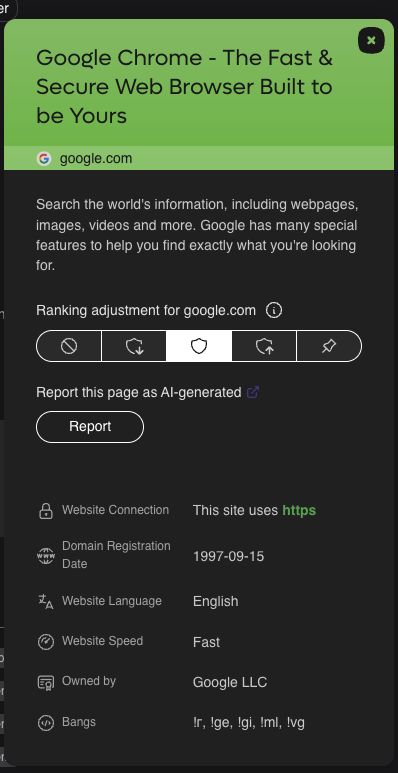
- AI integration that makes sense. In most products now, AI is screaming for your attention using dark patterns. In Kagi, AI is a supplemental tool you can use if you want.



I’ve listed just a few points, but there are many more, so you can try it and see for yourself.
In addition to the search engine, the subscription includes tools that make it even better.
Kagi and tools beyond the search
I sorted those tools in my likeness of the tool order
Translate
It's an analog of Google Translate and can do translations. I know that does not surprise anyone anymore, but this tool also has a proofreader.
SmallWeb
Remember when the internet was fun, and you could spend hours crawling from website to website, looking for unique content created by humans, and finding yourself on a random person's site about a topic you didn't even know existed, but now like too? This is the tool that uncovered a whole new internet within the internet for me. It lets you see a random post from a random personal website within their SmallWeb ring. It's not the only ring that exists, but it's the first one I found. After digging a bit, I learned a new term: IndieWeb. It's not only an alternative approach to having a personal website but also its own tech stack, like IndieAuth.
For me, it was the discovery of the year. At the moment of writing, most of the blog posts I see on the SmallWeb are about software development, but I think the topics there are versatile. In the past, I found many personal websites not related to software development. You can also try 🕸💍.ws, select Visit a Random site on the webring, and start discovering. At the bottom of every website in the ring, you can find the next button.
AI assistant
It's a regular AI chat with internet search capabilities. You can select one of many models to use.

The most notable feature is private chats that are removed after 24 hours by default unless they're pinned. So no one can collect your data, and everything is private even if you use AI models from companies that usually collect data.
Summarize
For me, it's the same thing as Quick Search and Assistant, so I'm not sure what to say about it.
News
A list of a limited number of the most important news. Updates daily and helps you reduce the amount of news that you consume.
I always find myself in a loop of the same news from all angles every day. Imagine ChatGPT launches a new model-you read about it in a minute, and that’s it, instead of seeing millions of YouTube videos, news articles, shorts, reels, TikToks, and podcasts about basically the same thing with no new information. It’s better to consume less than to consume more of the same.
Conclusion
I'm more than happy that I found Kagi.com, and I really hope that they will continue to deliver such amazing results. I also hope that if you read this post, you'll try Kagi.com and that you like it.